

Article
- +1
Toby Dalton, Mark Hibbs, Nicole Grajewski, …
{
  "authors": [
    "Mark Hibbs"
  ],
  "type": "other",
  "centerAffiliationAll": "dc",
  "centers": [
    "Carnegie Endowment for International Peace",
    "Malcolm H. Kerr Carnegie Middle East Center"
  ],
  "collections": [
    "Iranian Proliferation",
    "U.S. Nuclear Policy"
  ],
  "englishNewsletterAll": "ctw",
  "nonEnglishNewsletterAll": "",
  "primaryCenter": "Carnegie Endowment for International Peace",
  "programAffiliation": "NPP",
  "programs": [
    "Nuclear Policy"
  ],
  "projects": [],
  "regions": [
    "North America",
    "United States",
    "Middle East",
    "Iran"
  ],
  "topics": [
    "Political Reform",
    "Security",
    "Nuclear Policy",
    "Arms Control"
  ]
}
Source: Getty
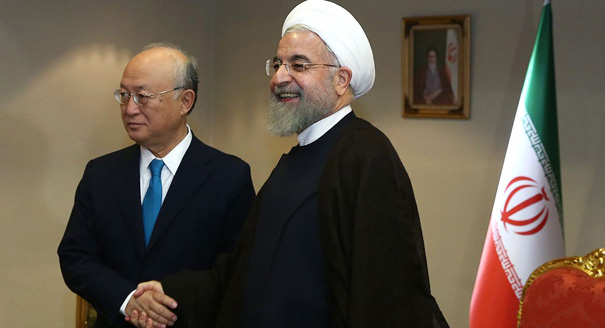
If all goes according to plan, sometime in the fall of 2023, the European Union and the United States will terminate the second of three tranches of nuclear sanctions against Iran, and Iran will initiate parliamentary ratification of its Additional Protocol for IAEA safeguards.
Source: Bulletin of the Atomic Scientists
The language of the Iran nuclear agreement is tricky, but there you have it: The “broader conclusion” (BC) is the goal for International Atomic Energy Agency (IAEA) verification efforts under the Joint Comprehensive Plan of Action (JCPOA) reached last week by Iran and six world powers. That's to say, at a future time while the JCPOA is in force, the IAEA may pronounce Iran’s nuclear declaration—that it has no undeclared nuclear activities, and that the entire program is for peaceful use—to be both correct and complete.
If all goes according to plan, sometime in the fall of 2023, the European Union and the United States will terminate the second of three tranches of nuclear sanctions against Iran, and Iran will initiate parliamentary ratification of its Additional Protocol for IAEA safeguards. The same day, the JCPOA says, the IAEA director general will submit a report to the IAEA Board of Governors and to the UN Security Council “stating that the IAEA has reached the Broader Conclusion that all nuclear material in Iran remains in peaceful activities.”That the BC would be the verification holy grail for Iran wasn’t certain in 2013, when talks began. Some officials prepping negotiators wanted the BC in the final accord as a sine qua non for ending the last remaining sanctions. But some others were doubtful; they argued that Iran had so far to go to explain its murky nuclear past that the IAEA could never award a BC to Iran. So to give an agreement with Iran a chance, they reasoned, it would be better not to use the BC as a yardstick.
The JCPOA looks like a compromise: The powers encourage Iran to get a BC from the IAEA inside of eight years, but if that doesn’t happen, it won’t prevent remaining nuclear sanctions from being terminated. Independent of the BC question, the JCPOA set deadlines for sanctions lifting because Iran, not without reason, feared that its adversaries, particularly Israel, would launch endless allegations against Iran that the IAEA would have to chase down. The deal instead permits Iran to anticipate that the sanctions clock will run out sometime in 2025 with or without a BC in hand from the IAEA.
For the IAEA to arrive at a BC requires a mountain of work, scouring every shred of data it can find on a state’s nuclear history and then putting all of it into a holistic context. Will eight years suffice? For a state like Iran with sensitive fuel cycle activities that may be limited in scope, the process might take six years or so, assuming Iran fully cooperates. Assessing Iran also might take less time because after 12 years of investigation, the IAEA already knows a lot about the country.
The route to a BC in Iran might have a roadblock ahead. The IAEA arrives at a BC during implementation of a state’s Additional Protocol, an enhanced inspection regime that gives the IAEA needed legal authority to get access to information, personnel, and locations beyond what’s allowed in a normal IAEA safeguards agreement. But the JCPOA permits Iran to implement its Additional Protocol without explicitly requiring that it enter into force. That provision is there to permit Iran to leverage its ratification against US lawmakers who may balk at lifting sanctions. Because Iran in the past reneged on voluntary Additional Protocol implementation, in 2013 the powers had foreseen Iran committing to ratify its Additional Protocol inside of one year. In the final agreement, the world powers are betting that, with hundreds of billions of dollars in sanctions relief at stake, and with a mechanism in place to snap sanctions back if Iran doesn’t cooperate, Iran will implement and ratify the protocol in good faith.
This article was originally published in the Bulletin of the Atomic Scientists.

Nonresident Senior Fellow, Nuclear Policy Program
Hibbs is a Germany-based nonresident senior fellow in Carnegie’s Nuclear Policy Program. His areas of expertise are nuclear verification and safeguards, multilateral nuclear trade policy, international nuclear cooperation, and nonproliferation arrangements.
Recent Work


Toby Dalton, Mark Hibbs, Nicole Grajewski, …
Mark Hibbs
Carnegie does not take institutional positions on public policy issues; the views represented herein are those of the author(s) and do not necessarily reflect the views of Carnegie, its staff, or its trustees.
In an interview, Mayssoun Sukarieh discusses youths in the region, and how they are being defined and reshaped.

Yasmine Zarhloule
It would provide a golden opportunity to reconsider what success looks like.

Michael Mazarr
The pressures of war are gradually warping Russia’s system of governance, making it more vulnerable to a future crisis.

Tatiana Stanovaya
The U.S. midterm elections signal the opening of a narrow window for bold Saudi diplomacy on Palestine.

Andrew Leber, Zaha Hassan

China’s political future will be shaped between now and next October. As the Communist Party enters its intense “campaign season” to prepare for a major political transition in 2027, reading Beijing's actions and responses may become more difficult as domestic politics weigh on its behavior more than usual.

Damien Ma