

Commentary
Marc Pierini
{
  "authors": [
    "Marc Pierini"
  ],
  "type": "legacyinthemedia",
  "centerAffiliationAll": "dc",
  "centers": [
    "Carnegie Endowment for International Peace",
    "Carnegie Europe",
    "Malcolm H. Kerr Carnegie Middle East Center"
  ],
  "collections": [
    "Turkey’s Transformation"
  ],
  "englishNewsletterAll": "ctw",
  "nonEnglishNewsletterAll": "",
  "primaryCenter": "Carnegie Europe",
  "programAffiliation": "EP",
  "programs": [
    "Europe"
  ],
  "projects": [],
  "regions": [
    "Middle East",
    "Europe",
    "Türkiye",
    "Gulf",
    "Levant",
    "Iraq",
    "Syria",
    "Iran"
  ],
  "topics": [
    "Political Reform",
    "Security"
  ]
}
Source: Getty
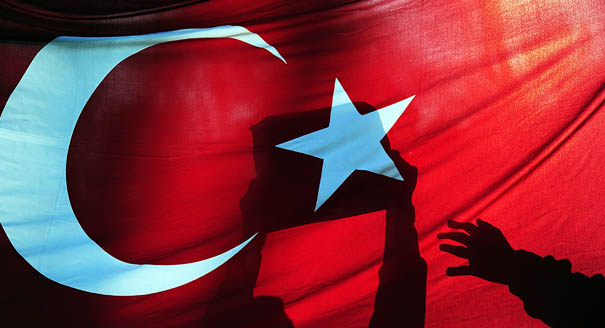
After military operations against the self-styled Islamic State in Syria and Kurdish separatists in Northern Iraq, Turkey’s strategy seems to be at a turning point.
Source: Australian Broadcasting Corporation
Turkey has called a special meeting of NATO ambassadors to discuss military operations against the self-styled Islamic State and Kurdish separatists, known as the PKK.
Turkey has been a reluctant ally in the campaign against the Islamic State, allowing the use of Turkish military bases for anti–Islamic State coalition air strikes but refusing to provide any military support of its own. But last week's bombing of a cultural center in Turkey by a man with suspected links to the Islamic State appears to have been a turning point.On July 24, Turkey launched its own wave of air strikes against the Islamic State in Syria. And, in a move that could vastly complicate the fight, Ankara also renewed its attacks against Kurdish militants in Northern Iraq, ending a shaky two-year ceasefire with the PKK, the Kurdistan People’s Party. In a parallel operation, antiterrorism police arrested almost 600 people accused of supporting the Islamic State or the PKK.
Kurdish forces have played a key role in the battle against the Islamic State, proving to be a far more effective fighting force than the Iraqi army, but Turkey has long been anxious about the consequences of arming the Kurds against the Islamic State.
On RN Breakfast, Marc Pierini discussed Turkey’s strategy with Fran Kelly.
This broadcast was originally aired on the Australian Broadcast Corporation’s RN Breakfast.

Senior Fellow, Carnegie Europe
Marc Pierini is a senior fellow at Carnegie Europe, where his research focuses on developments in the Middle East and Turkey from a European perspective.
Recent Work
Marc Pierini
Marc Pierini
Carnegie does not take institutional positions on public policy issues; the views represented herein are those of the author(s) and do not necessarily reflect the views of Carnegie, its staff, or its trustees.

The European Commissioner for Trade is headed to China. But after President Xi’s bridge-building visit to Washington, can a more isolated EU overcome Beijing’s stranglehold on critical raw materials? Who will blink first?

Rym Momtaz, ed.

European NATO countries are wrestling with the possibility of U.S. disengagement from the alliance. With the continent’s security increasingly uncertain, governments must restore the credibility of their collective defense.



Hans-Dieter Lucas, Adam Thomson, Pierre Vimont

The domestic impacts of how long it is taking to end the war in Ukraine have pushed the French electorate to the political extremes and compromised the country’s diplomatic capacity.
Rym Momtaz
A deep dive into the policy ecosystems behind battery development in China, South Korea, Japan, the European Union (including some of its member states), the United States, Canada, and India.


Milo McBride, Herbert Crowther, Darcie Draudt-Véjares, …

Sergei Kiriyenko used Russia’s parliamentary vote to further hone his strategy of corporate mobilization that is designed to maximize votes for United Russia.

Andrey Pertsev