

Other
- +18
James M. Acton, Saskia Brechenmacher, Cecily Brewer, …
{
  "authors": [
    "Marc Pierini"
  ],
  "type": "legacyinthemedia",
  "centerAffiliationAll": "dc",
  "centers": [
    "Carnegie Endowment for International Peace",
    "Carnegie Europe"
  ],
  "collections": [
    "Europe’s Southern Neighborhood"
  ],
  "englishNewsletterAll": "",
  "nonEnglishNewsletterAll": "",
  "primaryCenter": "Carnegie Europe",
  "programAffiliation": "EP",
  "programs": [
    "Europe"
  ],
  "projects": [],
  "regions": [
    "Middle East",
    "Europe",
    "Iraq",
    "Syria",
    "Western Europe",
    "France",
    "Germany",
    "Iran"
  ],
  "topics": [
    "Security",
    "Military",
    "Foreign Policy"
  ]
}
Source: Getty
The defense of a way of life, deeply rooted fundamental liberties, and the cohesion of entire societies is becoming a just cause for Europe to go to war.
Source: Washington Post
Before the most recent acts of terror in Paris, attacks in Belgium, Denmark and France over the past year have triggered strong rhetoric but relatively little action from the governments concerned. Several European countries joined the U.S.-led anti-Islamic State coalition and introduced measures to monitor their radicalized youth.
That changed abruptly on Nov. 13 following a massacre in the heart of Paris, where multiple suicide bombers killed 130 innocent civilians. Moreover, in the months of October and November alone, the Islamic State claimed more than 530 lives — in Ankara, the Sinai, Beirut, Paris, Bamako and Tunis — in attacks that appear to have been centrally planned from Raqqa, Syria.From a counter-terrorism standpoint, this form of coordinated, multi-country, multi-target terrorism is a quantum leap. From a European political standpoint, it is a political earthquake. Fighting terror will shake up the comfortable routine of Old Europe, forcing it to look at its foreign policy and rule-of-law standards in a new light. Many ask whether waging such a war is just.
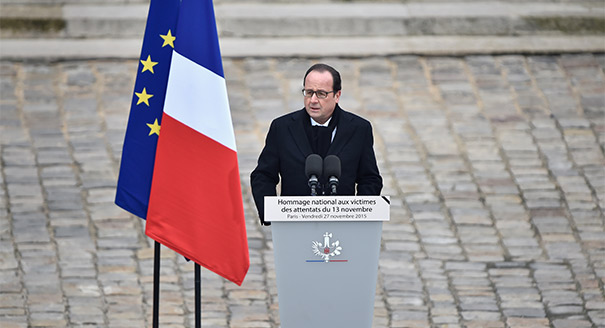
Days after the Paris carnage, President Francois Hollande told Parliament that “France is at war.” This is very unusual language on a continent where since the end of World War II leaders have made strenuous efforts to remove the word “war” from the political lexicon, and the loss of sizeable overseas territories in the 1950s and ’60s has resulted in downsized military forces and fewer operations abroad. Yet faced with aggressive assault to its heart and seeking to defend itself from further attack, France declared a new form of war. Here, Hollande correctly senses that the cause is necessary and just.
But Hollande faces several constraints: The French military is already engaged on several fronts, including missions in Mali and the Central African Republic; its budget is under scrutiny by E.U. institutions; and the country can hope only to share the operational burden of fighting the Islamic State in Syria with Britain, its sole E.U. partner with the ability to project sizeable military force. In terms of taking over some non-combat deployment or a chunk of the budgetary burden, Germany, France’s traditional political ally in E.U. affairs, is Paris’s main hope.
But for both Britain and Germany, waging war, or even supporting it out of European solidarity, is no simple matter. Britain’s House of Commons is called to vote on war powers on Wednesday, while Berlin’s aversion to engage militarily abroad — even for arms sales, transport missions or training operations — is deeply rooted in the guilt inherited from Nazi atrocities during WWII, although it may now change gradually. Forging a European consensus — not to speak of a coalition — when only one or two countries are directly targeted by the Islamic State’s mass terrorism is proving rather difficult. And will war without consensus be just?
Internationally, the issue is further complicated by the unusual set of “allies” in the war against the Islamic State: Russia and Iran certainly have the Islamic State in their sights (at least rhetorically), but they also have other not-so-acceptable objectives — such as supporting the Assad regime, itself an unpalatable “ally by proxy.” Is a war waged on the Islamic State jointly with Putin’s Russia still a “just war” in the eyes of the French and European citizens? Probably not, but perhaps reluctantly yes.
Domestically, the exceptional three-month-long state of emergency in France is welcomed by the public scared of further attack, but it also raises distinct worries around fundamental liberties such as freedom of speech. Hence, France fulfilled its obligation to report on these restrictions to the Council of Europe, the continent-wide institution that monitors human rights, democracy and rule of law. Yet conversely, new security constraints imposed on symbols of Europe’s freedom of movement, such as the fast train from Brussels to Paris, were well-received by travelers. A just cause, but will the costs to liberty outweigh the gains?
There are many considerations to weigh when deciding whether a war against the Islamic State is just, but perhaps the most fundamental factor in the eyes of the European public is the nature of the Islamic State’s threat.
The well-publicized narrative of the organization calls for nothing less than destroying the “infidels’ ” way of life, with sporting events, rock concerts and festive restaurants as its targets. Nothing could touch the citizens of Paris and Brussels more deeply than seeing their daily life — schools, shopping centers, mass transportation, recreation venues — and accustomed freedoms shaken by a terrorist organization for religious reasons. In addition, in France, Belgium, Germany and Sweden, sizeable Muslim populations are an integral part of the society. Hence the strong rejection, not least by European Muslims themselves, of the Islamic State’s declared intention to create a rift in the society.
The defense of not simply a way of life, but also deeply rooted fundamental liberties and the cohesion of entire societies, is indeed becoming — however slowly and painfully — a just cause for Europe to go to war.
This article was originally published in the Washington Post.

Senior Fellow, Carnegie Europe
Pierini is a senior fellow at Carnegie Europe, where his research focuses on developments in the Middle East and Turkey from a European perspective.
Recent Work



James M. Acton, Saskia Brechenmacher, Cecily Brewer, …
Marc Pierini
Carnegie does not take institutional positions on public policy issues; the views represented herein are those of the author(s) and do not necessarily reflect the views of Carnegie, its staff, or its trustees.

Just look at Iraq in 1991.

Marwan Muasher
Europe isn’t as weak in the new geopolitics of power as many would believe. But to leverage its assets and claim a sphere of influence, Brussels must stop undercutting itself.

Dimitar Bechev
The interventions in Iran and Venezuela are in keeping with Trump’s strategy of containing China, but also strengthen Russia’s position.

Mikhail Korostikov

Tehran’s attacks are reshaping the security situation in the Middle East—and forcing the region’s clock to tick backward once again.

Amr Hamzawy
Only collective security can protect fragile economic models.

Andrew Leber