

Commentary
Evan A. Feigenbaum
{
  "authors": [
    "Evan A. Feigenbaum"
  ],
  "type": "commentary",
  "centerAffiliationAll": "dc",
  "centers": [
    "Carnegie Endowment for International Peace"
  ],
  "collections": [
    "Ukraine’s Long Shadow"
  ],
  "englishNewsletterAll": "asia",
  "nonEnglishNewsletterAll": "",
  "primaryCenter": "Carnegie Endowment for International Peace",
  "programAffiliation": "AP",
  "programs": [
    "Asia"
  ],
  "projects": [],
  "regions": [
    "East Asia",
    "China",
    "Russia",
    "Eastern Europe",
    "Ukraine"
  ],
  "topics": [
    "Security",
    "Military",
    "Foreign Policy"
  ]
}
Source: Getty
Beijing’s strategy has been more supple in the past, so its evolution suggests that it has dramatically leaned toward Moscow.
Russia’s invasion of Ukraine is an important test of China’s policy evolution, tactical positioning, and strategic choices. Beijing is selfish about its own interests and will not want Washington to be the one to frame China’s alternatives. But Beijing is trying to strike an impossible balance by seeking to pursue three goals simultaneously: a strategic partnership with Russia, commitment to long-standing foreign policy principles of “territorial integrity” and “noninterference,” and a desire to minimize collateral damage from EU and U.S. sanctions.
Beijing cannot reconcile these three competing objectives. And since it cannot have all three, it will have to jettison one or another, or else uncomfortably shift its position from day to day under the glare of international scrutiny. China’s almost certain choice will be to abandon its principles while prioritizing power politics and practical considerations.
China does share some principles of international relations with Russia, including opposition to U.S.-led alliances, and a deep discomfort with U.S. foreign policy that dates to NATO intervention in the Balkans during the 1990s. But Russian actions flatly violate China’s often professed belief in sovereignty, territorial integrity, and noninterference. And these principles have supposedly been at the very core of Chinese foreign policy for decades.
In forsaking these principles while fudging that choice in a haze of sly diplomatic language, Beijing has made clear that the most decisive element of Chinese policy now is its lean toward Moscow.
Indeed, China’s position has shifted dramatically since 2008, when Russia invaded Georgia and two territories, Abkhazia and South Ossetia, were then recognized by Moscow as “independent” states. That action was a bellwether of Beijing’s policy because Russia embarrassingly failed to enlist China and other Shanghai Cooperation Organization partners to endorse its actions at a summit in Dushanbe, Tajikistan, attended by Russia’s then president Dmitri Medvedev a few weeks after the invasion. Six years later, when Russia annexed Crimea, Beijing moved closer to Moscow but sought to retain some flexibility by abstaining on key United Nations resolutions and avoiding overt endorsement of Russian arguments and positions. Today, however, Beijing is deploying some of Russia’s own arguments, while pointing the finger at Washington, not Moscow.
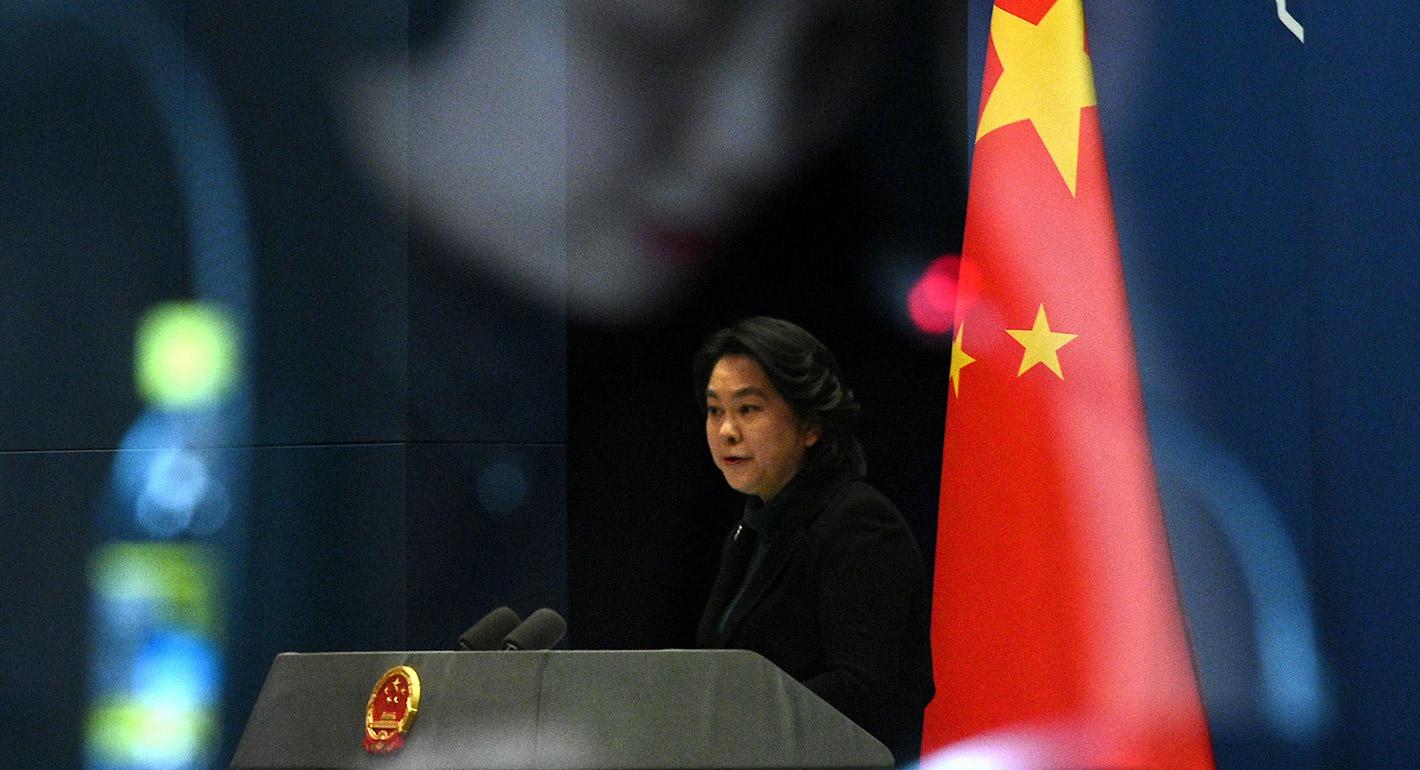
Beijing no doubt aims to avoid being dragged too directly into a conflict between Russia and the West, so Chinese statements have tried to straddle the un-straddleable, and China’s not-very-well-calibrated pronouncements reflect this. Last weekend, Foreign Minister Wang Yi referred to Ukraine’s “sovereignty, independence, and territorial integrity” in response to a question at the Munich Security Conference. Since then, his emphasis vanished from Chinese statements, buried instead under abstract references to the principles of the UN Charter, then suddenly reappeared. Most dramatically, Foreign Ministry spokesperson Hua Chunying has sought to shift the focus from Russian action to American policy, even calling the United States “the culprit” while piling on with a litany of both Russian and Chinese historical grievances. Given the sensitivity of current events, her formulation is surely a deliberate choice.
But these straddles will not be as feasible next week as they may seem to Beijing this week. China’s choices in the coming days—not just about language but also about whether it, in effect, allows Moscow to make it into a proxy for Russian policy—will matter greatly to relations with the United States and other countries. China will view that judgment as unfair, avowing that it is merely being “even-handed.” But the lean toward Moscow, especially when compared to 2008, is so notable that, as a practical matter, Beijing will not be able to avoid the perception that it is enabling Russian policy through silence, complicity, or even active support.
China’s erstwhile Communist leader Mao Zedong famously emphasized the importance of contradictions—the dialectical opposition of forces and influences that can be leveraged and balanced. This comprised the central thesis of “On Contradiction,” one of Mao’s two most famous theoretical essays, published in 1937. His text remains a seminal Chinese Communist Party tract, and today’s Chinese Marxists, including President Xi Jinping, continue to think in these terms, trying to leverage contradictions to ensure strategic advantage while maintaining tactical flexibility.
In Ukraine, Beijing faces unusually stark contradictions. And it will find these contradictions almost impossible to balance. It will pay a cost with the transatlantic West for its lean toward Moscow. It will pay a cost, too, for breaking with Moscow. China cannot avoid making choices, and these will decisively shape Chinese foreign policy for at least the next decade.

Vice President for Studies
Evan A. Feigenbaum is vice president for studies at the Carnegie Endowment for International Peace, where he oversees work at its offices in Washington, New Delhi, and Singapore on a dynamic region encompassing both East Asia and South Asia. He served twice as Deputy Assistant Secretary of State and advised two Secretaries of State and a former Treasury Secretary on Asia.
Recent Work
Evan A. Feigenbaum
Evan A. Feigenbaum
Carnegie does not take institutional positions on public policy issues; the views represented herein are those of the author(s) and do not necessarily reflect the views of Carnegie, its staff, or its trustees.

Ahead of a tough winter for Ukraine, Donald Trump’s swing back toward Russia bodes ill. But instead of panicking, Kyiv’s European allies are focusing on action.

Rym Momtaz

Without a ceasefire with Ukraine on attacking each other’s energy infrastructure—to which the Kremlin is unlikely to agree—the diesel agreement between Putin and Trump is largely for show, rather than representing a genuine increase in the volumes of Russian diesel on the global market.

Sergey Vakulenko

Funding Ukraine remains a priority for European leaders. As Russia’s war of aggression heads into another winter, two feasible options to mobilize support for Kyiv should be fast-tracked.


Vladyslav Rashkovan, Gregory P. Wilson

Russian strikes are weakening the economy sustaining Ukraine’s war effort. Closing the growing funding gap will require more European support and politically contentious reforms in Kyiv.

Balázs Jarábik

While the EU and European governments are embracing the much-lauded middle-power moment, this entails three difficult conundrums.

Richard Youngs