• Research
  • Emissary
  • About
  • Experts
Carnegie Global logoCarnegie lettermark logo
DemocracyIran
  • Donate
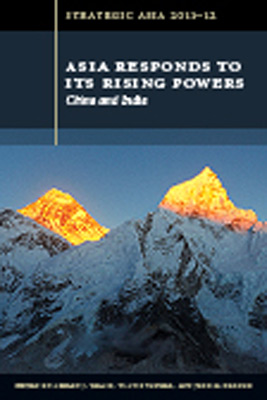
Strategic Asia 2011-2012: Asia Responds to Its Rising Powers - China and India
Book

Strategic Asia 2011-2012: Asia Responds to Its Rising Powers - China and India

Asian states are adopting new strategies to preserve their national interests, prompted by the rising power of India and China. These strategies have implications for U.S. interests and leadership in the Asia-Pacific.

Link Copied
By Ashley J. Tellis, Travis Tanner, Jessica Keough
Published on Sep 14, 2011

Additional Links

Overview by Ashley J. Tellis
Program mobile hero image

Program

South Asia

The South Asia Program informs policy debates relating to the region’s security, economy, and political development. From strategic competition in the Indo-Pacific to India’s internal dynamics and U.S. engagement with the region, the program offers in-depth, rigorous research and analysis on South Asia’s most critical challenges.

Learn More

Source: The National Bureau of Asian Research

Co-edited and introduced by Ashley Tellis, with chapters by leading Asia specialists including Dmitri Trenin, director of the Carnegie Moscow Center, this book, the eleventh volume in NBR’s Strategic Asia series, explores how Asian states are responding to the rise of China and India and the strategies these states are pursuing to preserve their national interests. In each chapter, a leading expert investigates how a country or region perceives China’s and India's growth based on geopolitical, economic, cultural, military, and historical interactions and draws implications for U.S. interests and leadership in the Asia-Pacific.

Order this book, or read the introduction by Ashley J. Tellis for free.

About the Editors:

Ashley J. Tellis, Senior Associate at the Carnegie Endowment for International Peace and Research Director of the Strategic Asia Program at NBR, served in the U.S. Department of State as senior adviser to the Undersecretary of State of Public Affairs, and previously as senior adviser to the Ambassador at the U.S. Embassy in India. He also served on the National Security Council Staff as special assistant to the President and senior director for Strategic Planning and Southwest Asia. He is the author of India’s Emerging Nuclear Posture (2001) and co-author of Interpreting China’s Grand Strategy: Past, Present, and Future (2000), as well as the co-editor of seven most recent volumes of Strategic Asia, published by NBR.

Travis Tanner is the Senior Project Director and Director of the Pyle Center for Northeast Asian Studies at the National Bureau of Asian Research.

Jessica Keough is the Publications Director at the National Bureau of Asian Research.

About the Authors

Ashley J. Tellis

Former Senior Fellow

Ashley J. Tellis was a senior fellow at the Carnegie Endowment for International Peace.

Travis Tanner

NBR

Jessica Keough

The National Bureau of Asian Research

Authors

Ashley J. Tellis
Former Senior Fellow
Travis Tanner
NBR
Jessica Keough
The National Bureau of Asian Research
North AmericaUnited StatesSouth AsiaIndiaEast AsiaChinaCentral AsiaSoutheast AsiaCaucasusRussiaOceaniaPolitical ReformDemocracyEconomyTradeSecurityMilitaryForeign Policy

Carnegie does not take institutional positions on public policy issues; the views represented herein are those of the author(s) and do not necessarily reflect the views of Carnegie, its staff, or its trustees.

More Work from Carnegie Endowment for International Peace

  • Commentary
    Strategic Europe
    Europe and the Arab Gulf Must Come Together

    The war in Iran proves the United States is now a destabilizing actor for Europe and the Arab Gulf. From protect their economies and energy supplies to safeguarding their territorial integrity, both regions have much to gain from forming a new kind of partnership together.

      • Rym Momtaz

      Rym Momtaz

  • Photo of Ukrainian soldiers against a setting sun.
    Article
    Rethinking Ukraine’s Manpower Challenge

    Strategy and force design are key to solving Kyiv’s persistent manning and readiness problems.

      • Andriy Zagorodnyuk

      Viktor Kevliuk, Olesya Favorska, Andriy Zagorodnyuk

  • Commentary
    Carnegie Politika
    Why Has Kazakhstan Started Deporting Political Activists?

    The current U.S. indifference to human rights means Astana no longer has any incentive to refuse extradition requests from its authoritarian neighbors—including Russia.

      Temur Umarov

  • people walking with suitcases
    Commentary
    Emissary
    Iran’s Northern Neighbors Are Facing Fallout From the War, Too

    The conflict is threatening stability in Armenia and Azerbaijan.

      Zaur Shiriyev

  • Japanese Prime Minister Sanae Takaichi delivers a speech during the graduation ceremony at the National Defense Academy of Japan on March 14, 2026 in Yokosuka, Kanagawa Prefecture, Japan.
    Article
    Revisiting Japan’s Non-Nuclear Principles: Between a Nuclear Allergy and Umbrella

    Japan’s prime minister, Takaichi Sanae, may kickstart a discussion on Japan’s non-nuclear principles.

      Shizuka Kuramitsu

Get more news and analysis from
Carnegie Endowment for International Peace
Carnegie global logo, stacked
1779 Massachusetts Avenue NWWashington, DC, 20036-2103Phone: 202 483 7600Fax: 202 483 1840
  • Research
  • Emissary
  • About
  • Experts
  • Donate
  • Programs
  • Events
  • Blogs
  • Podcasts
  • Contact
  • Annual Reports
  • Careers
  • Privacy
  • For Media
  • Government Resources
Get more news and analysis from
Carnegie Endowment for International Peace
© 2026 Carnegie Endowment for International Peace. All rights reserved.