

Commentary
Judy Dempsey
{
  "authors": [
    "Judy Dempsey"
  ],
  "type": "legacyinthemedia",
  "centerAffiliationAll": "dc",
  "centers": [
    "Carnegie Endowment for International Peace",
    "Carnegie Europe",
    "Carnegie Russia Eurasia Center"
  ],
  "collections": [
    "Europe’s Eastern Neighborhood"
  ],
  "englishNewsletterAll": "ctw",
  "nonEnglishNewsletterAll": "",
  "primaryCenter": "Carnegie Europe",
  "programAffiliation": "russia",
  "programs": [
    "Russia and Eurasia"
  ],
  "projects": [],
  "regions": [
    "Asia",
    "Russia",
    "Europe",
    "Eastern Europe",
    "Central Asia",
    "Kazakhstan",
    "Caucasus",
    "Azerbaijan",
    "Armenia",
    "Georgia",
    "Ukraine",
    "Western Europe",
    "Belarus",
    "Moldova"
  ],
  "topics": [
    "Foreign Policy"
  ]
}
Source: Getty
Russia and the European Union are competing intensely for influence in Ukraine, Belarus, Moldova, Georgia, Armenia, Azerbaijan, and other countries.
Source: New York Times
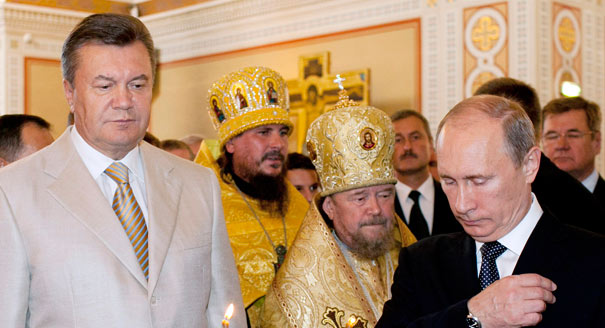
When President Vladimir V. Putin of Russia visited Ukraine last month, he said the historical ties between both countries mattered as much today as they had in the past.
“Our forebears lived for centuries together, worked together, defended their common homeland and made it strong, great and invincible,” Mr. Putin told Russian and Ukrainian naval forces in the port of Sevastopol. “Our blood and spiritual ties are unbreakable.”
He suggested that the armed forces of both countries be integrated. Ukraine’s president, Viktor F. Yanukovich, was less than noncommittal. He said there was scope for cooperating in modernizing the armed forces.Mr. Putin’s comments reflect ever more urgent attempts to woo Ukraine into Russia’s Common Economic Space, an economic bloc that Belarus and Kazakhstan have already joined and that Russia uses to consolidate its influence in the region.
These attempts come at a time of intense competition between Russia and the European Union for influence over the new Eastern Europe, analysts say, including Belarus and Ukraine as well as Moldova, Georgia, Armenia and Azerbaijan.
These countries belong to the European Union’s Eastern Partnership, known as the EaP, whose goal is to integrate them within the bloc through democratization and free market economies. In return, the European Union will expand trade, liberalize the visa systems and give financial assistance.
Russia, however, opposes these countries’ moving closer to the European Union. “Moscow clearly fears losing influence over this region. But is the EaP so great that it can counter the pull of the Kremlin?” said Eugeniusz Smolar, a regional expert at the Polish Institute of International Affairs in Warsaw.
So far, the Eastern Partnership’s record concerning political and economic liberalization has been mixed. Moldova, Georgia, Ukraine and Armenia are partly democratic, while Belarus and Azerbaijan are authoritarian, according to the Economist Intelligence Unit.
“The Eastern Partnership has turned out to be a predominately bureaucratic instrument with limited political significance,” said Rafal Sadowski, an Eastern Partnership expert at the Center for Eastern Studies in Warsaw. “This shows the limits of the E.U.’s ability to influence its eastern neighborhood,” he added in a new report.
Despite that, Lithuania, which last month took over the European Union’s rotating presidency, is doing everything possible to draw these countries closer to Europe. Vilnius has invited the six countries to an Eastern Partnership summit meeting next November.
For Lithuania, and its neighbor Poland, which has pushed hard for a closer relationship between the European Union and the Eastern Partnership countries, the crowning moment of the summit meeting would be the signing of an association agreement between the European Union and Ukraine, the Eastern Partnership’s biggest member.
Such an agreement would bring economic and political advantages to both sides. It would also encourage Ukraine’s reformers and pro-Western political movements to pursue the modernization of its economy and strengthen the rule of law.
The association agreement with Ukraine is “not just technical negotiations with just another partner; it is a geopolitical process,” said Lithuania’s foreign minister, Linas A. Linkevicius.
The European Union and Ukraine initialed the agreement more than a year ago, but it has not been signed. Ukraine still has to introduce more reforms.
The German government has been the most vocal in insisting that Ukraine release from prison the former prime minister Yulia V. Tymoshenko, who is ill. She was sentenced in 2011 for abuse of office. On a visit to Ukraine last June, Foreign Minister Guido Westerwelle of Germany said that Ms. Tymoshenko had not been given a fair trial. He offered to transfer her to Germany for medical help.
“Mrs. Tymoshenko, in our opinion, has the right to a fair trial and appropriate medical assistance,” Mr. Westerwelle said. Germany was expected to veto signing the association agreement unless Ukraine introduced reforms that included dealing fairly with political detainees like Ms. Tymoshenko.
Mr. Yanukovich’s failure to resolve Ms. Tymoshenko’s status is not the only sticking point between the European Union and Ukraine. The other is Ukraine’s lack of commitment.
Over the past several years, Mr. Yanukovich has repeatedly played the European Union and Russia against each other in order to extract concessions from both: better trade access in the case of the European Union; and access to cheaper energy from Russia.
Ukrainian public opinion by a small margin supports the country moving closer to the European Union. A survey carried out last May by the International Republican Institute, an American nonprofit, nonpartisan organization that promotes democracy, showed that 40 percent of Ukrainian respondents wanted an “international economic union” with the European Union, while 37 percent favored Russia’s Customs Union. With such a divide, Mr. Yanukovich will have to weigh the political costs of taking a stance before 2015, when the next presidential elections are planned.
Ukraine’s decision — and what happens politically and economically to the other Eastern Partnership countries — matters to Europe. It is not just about countering Russia’s influence. It is about whether these countries are prepared to embrace democracy, which Russia has little interest in. Mr. Smolar says the European Union’s offer of better trade access and closer political contacts is helpful, but not enough.
During the 1990s, the countries of Eastern Europe were motivated to introduce reforms because they had the prospect of E.U. membership. That was the most important catalyst for reform. Eastern Partnership countries, however, are denied that promise.
Because of that, many of the region’s elites and oligarchs see no need for reform, and reformers are frustrated, said Mr. Sadowski of the Center for Eastern Studies. In the competition over the Eastern Partnership countries, that could benefit Russia. It could also lead to instability if the European Union allowed the new Eastern Europe to drift.
This article was originally published in the New York Times.

Nonresident Senior Fellow, Carnegie Europe
Judy Dempsey is a nonresident senior fellow at Carnegie Europe
Recent Work
Judy Dempsey
Judy Dempsey
Carnegie does not take institutional positions on public policy issues; the views represented herein are those of the author(s) and do not necessarily reflect the views of Carnegie, its staff, or its trustees.
It should address the shortcomings of previous crisis communication efforts and adapt to the demands of frontier AI.

Lucy Luo

If the Russian-speaking community in Latvia cannot articulate their interests without being seen as disloyal, they could end up embracing a pro-Kremlin agenda.

Sergejs Potapkins
Washington’s decision to support some UN functions while letting others wither is pulling the organization apart at the seams.

Stewart Patrick, Theodore Zaritsky

Are Germany’s economic, industrial, and political struggles becoming a liability for the EU’s ability to rise to the geopolitical moment?

Rym Momtaz, ed.

Russia’s ruling party would have benefited from Putin appearing as its distant patron, but as an active frontman imposing his views on the public, he has done nothing but harm both the party’s election campaign and the ruling system overall.

Andrey Pertsev