

Commentary
Lilia Shevtsova
{
  "authors": [
    "Lilia Shevtsova"
  ],
  "type": "legacyinthemedia",
  "centerAffiliationAll": "",
  "centers": [
    "Carnegie Endowment for International Peace",
    "Carnegie Russia Eurasia Center"
  ],
  "collections": [],
  "englishNewsletterAll": "",
  "nonEnglishNewsletterAll": "",
  "primaryCenter": "Carnegie Russia Eurasia Center",
  "programAffiliation": "",
  "programs": [],
  "projects": [],
  "regions": [
    "Russia",
    "Eastern Europe",
    "Ukraine"
  ],
  "topics": [
    "Political Reform",
    "Security",
    "Foreign Policy"
  ]
}
Source: Getty
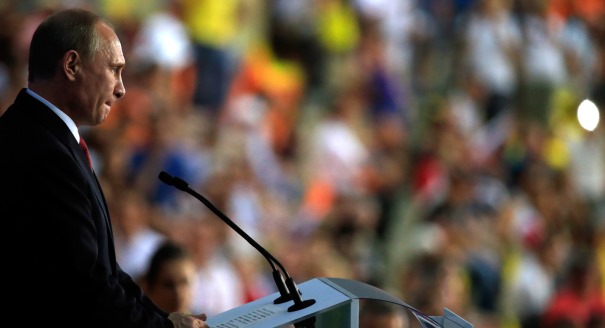
By turning Russia into a war state, President Putin has unleashed a process he cannot stop and made himself hostage to suicidal statecraft.
Source: Financial Times
Tactical victories often end in strategic defeats. That is what Vladimir Putin is in for. The Russian president’s calculations appeared correct at first: the west swallowed the annexation of Crimea, and the Ukrainians did not resist for fear of all-out war. That put Russia on the path of military-patriotic mobilisation, enabling Mr Putin to claim absolute power without resorting to mass repressions. Yet by turning Russia into a war state, Mr Putin has unleashed the process he cannot stop and made himself hostage to suicidal statecraft.
He cannot now exit the war paradigm without risking a loss of power. For now he makes deals and wears a peacemaker’s hat, but he will inevitably return to the besieged fortress. He can rule only by subjugating the nation in a way that only war can justify. Russians will remember their economic problems soon enough.
Mr Putin has dismantled the post-cold war settlement that allowed him to engage economically with the west in the interests of the Russian petrostate, while keeping Russian society closed to western influence. His aggression has ensured Russia’s Ukrainian neighbour will forever look west.The peace plan Mr Putin announced in September, which was instrumental in securing a ceasefire, is an attempt to formalise the new status quo. The alternative, the Kremlin makes clear, is continued bloodshed. It will not relinquish the occupied territories, and its offer of a deal is backed by dark threats from a country that still possesses one of the world’s biggest nuclear arsenals.
The west dare not call the Russian incursion an act of aggression. They talk euphemistically of a “political solution” to the Ukrainian crisis, which means that the Kremlin’s interests should be taken into account. The Nato summit held in Wales this month demonstrated that the alliance is not prepared to do much more than condemn Russia.
The promises of lethal aid for Ukraine that have apparently been made by some Nato countries will not shift the military balance – though both sides have an interest in pretending otherwise. Western sanctions will not force Mr Putin to backtrack. The west has proved that it is neither ready to include Ukraine in its security umbrella, nor to live up to their commitments under international law as guarantors of Ukrainian territorial integrity. A New Russia (or “Novorossiya”) on the territory controlled by pro-Russian separatists is on its way to becoming a reality. The partition of Ukraine is silently being ratified by the rest of the world.
Does this mean that Mr Putin is winning? Just the reverse: he is again miscalculating. He thinks he can do what other Russian leaders have done before – subdue his subjects by putting Russia in a state of permanent confrontation with the outside world. But the propaganda that plays endlessly on Russian television channels will not mesmerise them for long. Russian society will only accept short and victorious war. It is not prepared for bloodshed.
Few are willing to die for Mr Putin’s regime. News that hundreds of Russian soldiers had been killed in Ukraine and their bodies secretly buried in Russia has already begun to undermining the patriotic mood.
Soon, declining living standards will also begin to chafe, and Russians will start asking why they are suddenly so much worse off. Already, 37 per cent of Russians believe that the interests of individuals should trump the interests of the state. Mr Putin is not the new Stalin. He cannot mobilise Russia for a Great Patriotic War.
The irony is that Novorossiya will soon become a problem for the Russian president. The Kremlin will have to contend with heavily armed separatists, embittered by their failure to secure a stipend from Moscow, just as the tide of protest begins to rise at home.
Moscow will have to keep its heroes at arm’s length. Those who are bravely fighting for a “Russian world” could quickly become a threat to Mr Putin if they were allowed into Russia proper. They are welcome in the motherland, but only in coffins.
This article was originally published in the Financial Times.
Former Senior Associate, Russian Domestic Politics and Political Institutions Program, Moscow Center
Shevtsova chaired the Russian Domestic Politics and Political Institutions Program at the Carnegie Moscow Center, dividing her time between Carnegie’s offices in Washington, DC, and Moscow. She had been with Carnegie since 1995.
Recent Work
Lilia Shevtsova
Lilia Shevtsova
Carnegie does not take institutional positions on public policy issues; the views represented herein are those of the author(s) and do not necessarily reflect the views of Carnegie, its staff, or its trustees.

Japan’s long-term security policy is driven by concerns about China, and there is little appetite for (or interest in) pursuing a confrontation with Moscow.

James D.J. Brown

Russia is testing the waters of NATO’s mutual defense clause. What do strikes in Romanian territorial waters mean for the alliance’s posture toward Moscow?

Dimitar Bechev
Why Pakistan, Saudi Arabia, and Turkey are joining forces on regional security.


Alper Coşkun, Amr Hamzawy

The truth of the strategic situation is that Europe and Russia are extremely unlikely to be able to “turn the page” on their confrontation within the next two decades.

Arkady Moshes

Despite public disputes over trade and immigration, the strategic partnership’s foundations remain sturdy.

Sameer Lalwani