

Report
- +9
Richard Youngs, Erik Jones, Dan Baer, …
{
  "authors": [
    "Rosa Balfour"
  ],
  "type": "commentary",
  "centerAffiliationAll": "dc",
  "centers": [
    "Carnegie Endowment for International Peace",
    "Carnegie Europe"
  ],
  "collections": [
    "Europe’s Eastern Neighborhood",
    "EU Integration and Enlargement"
  ],
  "englishNewsletterAll": "ctw",
  "nonEnglishNewsletterAll": "",
  "primaryCenter": "Carnegie Europe",
  "programAffiliation": "EP",
  "programs": [
    "Europe"
  ],
  "projects": [],
  "regions": [
    "Europe",
    "Eastern Europe",
    "Caucasus",
    "Georgia",
    "Ukraine",
    "Western Europe",
    "Belarus",
    "Moldova",
    "Iran"
  ],
  "topics": [
    "Foreign Policy",
    "EU",
    "Security"
  ]
}
Source: Getty
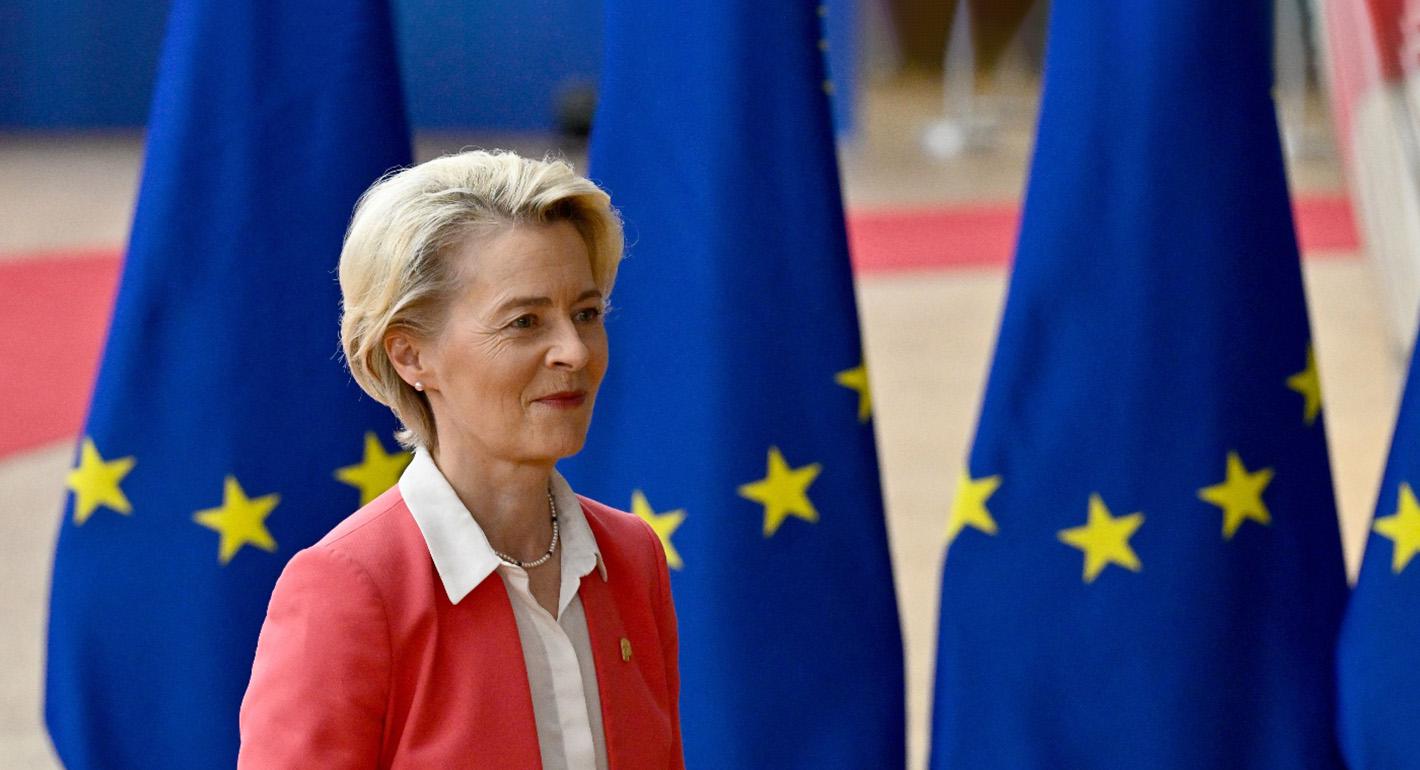
The European Commission president’s remarks will be a guide for understanding how she might navigate upcoming turbulence.
These days, the gossip in Brussels is focused on whether Ursula von der Leyen will get another mandate as European Commission president in 2024. Under her four years of leadership, the EU has embarked on major transitions: toward a green and digital economy, building up its security and defense, laying out policies to beef up its economic security. In doing so, the EU has taken on tasks previously unthinkable, from procuring vaccines to financing arms delivery.
On Wednesday, Brussels will get a glimpse into von der Leyen’s mindset. Her State of the Union speech is widely expected to focus on her achievements. Regardless of whether it will be a legacy speech or a bid for another mandate, it will be a guidepost to gauge how the EU will deal with the big upcoming challenges. The challenges come in three interconnected tiers—local, regional, global—whose links will be critical for Europe in the year ahead.
The first tier of challenges refers to the politics of the year to come. The national elections punctuating the calendar before the European Parliament elections in June will be noisy and turbulent. The ambition of an agenda shaped by the coronavirus pandemic and war in Europe—and the surprising political unity to back it so far—is bound to meet backlash amid fears of a continued rise of the far right.
Among the issues likely to feature prominently in these elections is support for Ukraine. Responding to Russia’s invasion of Ukraine has put EU diplomacy on decisionmaking steroids, requiring deft navigation through the many differences of the twenty-seven member states. Last year, pundits widely expected popular fatigue over the costs of supporting Ukraine. They were wrong. European commitment to Ukraine did not waver—yet. But as Ukraine’s counteroffensive is not delivering the anticipated breakthrough, the European consensus may start to crack. Slovakia’s election at the end of September may produce a government that includes parties sympathetic to Russia. The risk that a new government in Bratislava joins Hungary, a constant spoiler of EU foreign policy when it comes to Russia, making continued consensus-building even more challenging.
Another issue is the green transition. Under von der Leyen’s Commission, the European Green Deal became a project embraced by mainstream political parties. Now challenges are popping up from her own political family. The recent vote in the European Parliament on the Nature Restoration Law saw the European People’s Party campaign with the far right to vote against the bill. The far right is increasingly vociferous in criticizing the Green Deal, which it says is imposed by “Brussels technocrats” or by “climate activists.” The conservative right is worried about its continuous hemorrhage of votes to the far right and is shifting its position on climate as a result. Like with migration, climate politics risks a right-wing turn carried out by centre-right parties.
The second tier of challenges lies in preparing for a credible EU enlargement. This task will be both formidable and existential. It is formidable because of the risks of being surrounded by authoritarian states under the threat or influence of Moscow. Even French President Emmanuel Macron, whose country has been historically skeptical of enlargement, has recognized the geopolitical logic behind EU expansion. And the task is existential because EU enlargement requires huge reforms, over which there is no agreement. Among them is the question of the rule of law in Europe. If Poland confirms the current government in its October election, the EU will struggle to find an agreement on the democratic standards necessary to underpin a revitalized and effective enlargement to the Western Balkans, Ukraine, Moldova, and possibly Georgia.
The third tier is as important as the previous two, but it has been so neglected that the EU is only just managing to play catch-up: relations with the non-G7 world, where powers are scrambling for influence and access to critical materials. The BRICS expansion and the string of coups in Africa, to name a couple of recent events, illustrate not just the waning influence of the West but the willingness of leaders around the world to gamble on a la carte foreign policy—particularly in the emerging multipolar international context, where hedging and transactional politics seem to reap dividends. Here, the EU’s traditional offer of trade and investment has lost its attraction, and its request to contain migration toward Europe smacked of double standards. The EU is still fumbling to find the language, diplomacy, and tools to engage with the diverse expectations in the so-called Global South. Yet it still has much to offer to the democratically minded countries that are willing to go beyond transactional politics by connecting them to the EU’s own green, digital, and security transition.
The EU needs effective decisionmaking to steer through its ongoing transitions. Its own resilience depends on building a safe European continent, which cannot exist in isolation from global relationships. Von der Leyen’s continued ability to navigate troubled waters while also focusing on the horizon will likely decide whether she gets another stint at the helm of the European Commission. Her State of the Union speech should reveal much about the wisdom of her planned route.

Director, Carnegie Europe
Rosa Balfour is the director of Carnegie Europe. Her fields of expertise include European politics, institutions, and foreign and security policy.
Recent Work


Richard Youngs, Erik Jones, Dan Baer, …
Rosa Balfour
Carnegie does not take institutional positions on public policy issues; the views represented herein are those of the author(s) and do not necessarily reflect the views of Carnegie, its staff, or its trustees.

Before the next wave of EU enlargement takes place, the union needs to grapple with thorny questions of how power is distributed among its members.


Emil Sondaj Hansen, Ditte Brasso Sørensen
The real test may come after the leaders leave the room.



Sheena Chestnut Greitens, Oriana Skylar Mastro, Yukon Huang, …

The Horn of Africa countries are among those facing a new security calculus.


Andrew Leber, Lesley Anne Warner

The European far right might fail to steer EU policy in the direction Russia wants, but they will create enough chaos inside Europe to benefit the Kremlin.

Dimitar Bechev

The new U.S.–Denmark–Greenland agreement will help Washington exert political, economic, and financial dominance under the guise of security. Yet, it acknowledged Copenhagen’s and Nuuk’s sovereignty on the island.

Marc Pierini