

Commentary
The EU can impose sanctions but struggles to enforce them without the United States. With Washington increasingly disinterested in backing European interests, the bloc must now fend for itself.
Nicu Popescu, Tiago Antunes
{
  "authors": [
    "Zainab Usman",
    "Alexander Csanadi"
  ],
  "type": "other",
  "centerAffiliationAll": "dc",
  "centers": [
    "Carnegie Endowment for International Peace"
  ],
  "collections": [
    "Climate and Energy Transitions",
    "Trade and Investment",
    "Africa’s Natural Resources in the Global Energy Transition",
    "Africa’s Shifting Politics and Geopolitics",
    "Clean Energy Transition"
  ],
  "englishNewsletterAll": "africa",
  "nonEnglishNewsletterAll": "",
  "primaryCenter": "Carnegie Endowment for International Peace",
  "programAffiliation": "AFP",
  "programs": [
    "Africa",
    "Sustainability, Climate, and Geopolitics"
  ],
  "projects": [
    "The U.S. Foreign Policy for Clean Energy Taskforce"
  ],
  "regions": [
    "Southern, Eastern, and Western Africa"
  ],
  "topics": [
    "Economy",
    "Foreign Policy"
  ]
}
Source: Getty
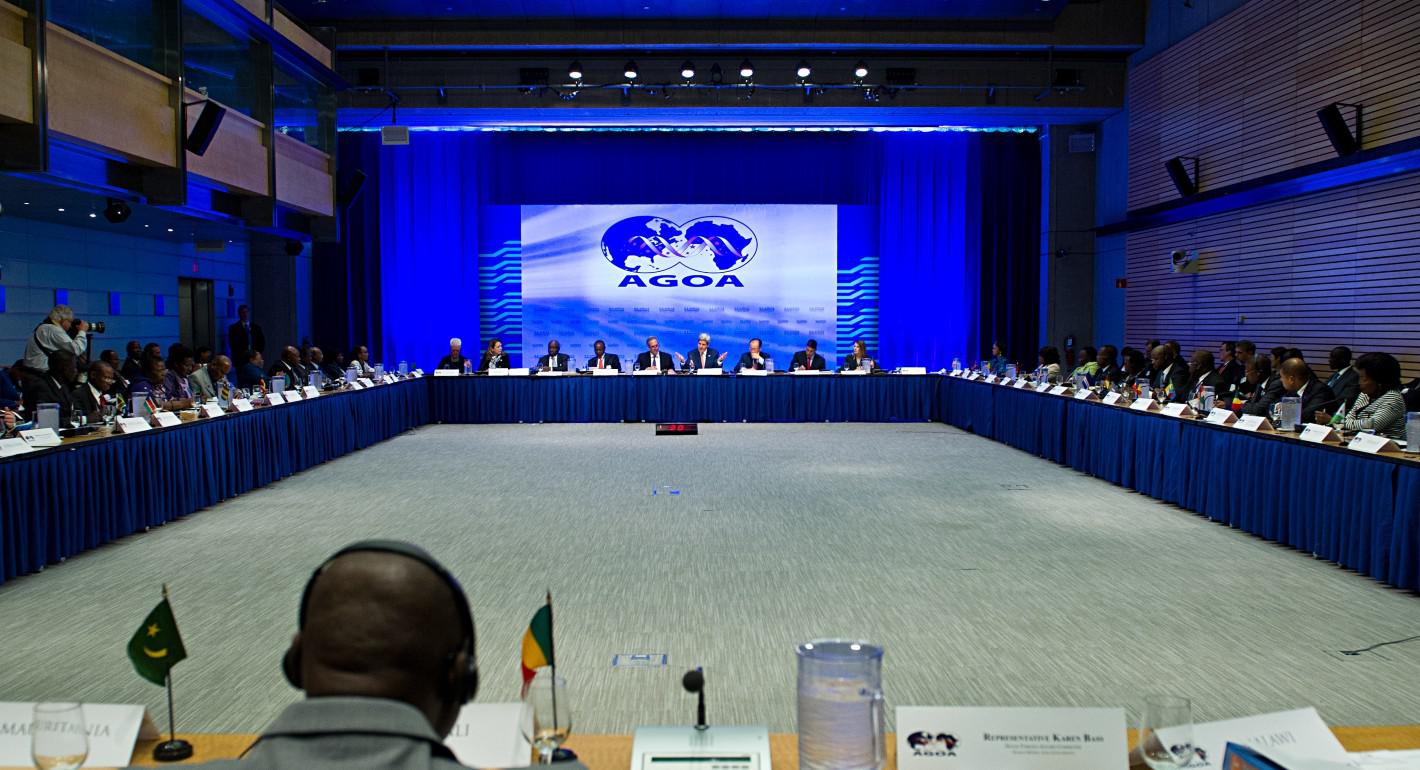
The ongoing African Growth and Opportunity Act reauthorization process could facilitate the expansion of U.S.-Africa trade in critical minerals.
The United States is currently seeking to source the supplies of minerals and metals that are “critical” to support its clean energy transition and diversify the attendant supply chains away from geopolitical competitors.1 African countries have many of these critical minerals in abundance and already supply some of these resources to the United States. These countries also seek to attract investments in value addition for these commodities to support their industrialization objectives. There is scope to increase the aggregate minerals and metals trade between the United States and Africa both in terms of volume and composition by investing in the processing and refining of these commodities on the African continent, which will also reduce U.S. dependence on China. The African Growth and Opportunity Act (AGOA) provides an opening to achieve these objectives. Since September 2023, discussions have been underway—the AGOA midterm review at the African Union, the AGOA Forum in Johannesburg, as well as multiple briefings and symposia in Washington, DC—on the future of the trade program: the prospects of the legislation’s reauthorization before its expiry in 2025, enhancements around the program’s scope, and how to make it better attuned to the geopolitical realities of the 2020s.
The ongoing AGOA reauthorization process could facilitate the expansion of U.S.-Africa trade in critical minerals, which would be mutually beneficial for all parties. Such trade expansion could serve both the strategic interests of the United States, by diversifying the sources of critical minerals, as well as the economic interests of African countries by attracting investments in value chain development of these commodities. It could also demonstrate the U.S. commitment to shifting the U.S.-Africa relationship from one premised on aid arrangements to a twenty-first-century economic partnership.
As the reauthorization process proceeds, we draw on recommendations outlined in a recent Carnegie paper on how African countries can participate in U.S. clean energy supply chains2 to consider three options: (1) exempt eligible African mineral producers from Inflation Reduction Act (IRA) restrictions in order to diversify U.S. supply chains and advance African value-addition objectives, (2) reframe the U.S.-Africa trade relationship into a strategic economic partnership for a new era, and (3) negotiate a new critical minerals agreement (CMA).
It is clear that the United States and Africa share mutual interests regarding minerals critical for the clean energy transition. Therefore, the AGOA reauthorization could provide an opening for bringing African mineral producing countries into the orbit of emerging U.S. clean energy supply chains. AGOA already covers trade in minerals. However, because it is not a reciprocal free trade agreement (FTA), the language of the IRA risks excluding African-sourced minerals used in electric vehicle (EV) batteries from qualifying for the Section 30D tax credits. In general, Section 30D of the IRA offers a total incentive of $7,500 in tax credits—broken down into two equal ($3,750) components—for the purchase of EVs by consumers. This was designed to encourage producers to retain the entirety of the clean energy value chain within the U.S. ecosystem, subject to several requirements. The main relevant component here relates to requirements around the percentage of the value of critical minerals used in EV batteries that were extracted and processed in the United States or a country with which the United States has an FTA, or recycled in North America. These sourcing requirements begin at 50 percent in 2024 and scale up each year to 80 percent by 2027. The Section 30D tax credit is set to expire after December 31, 2032.
This impending exclusion of African countries from Section 30D tax credits would inadvertently undermine U.S. interests of supporting domestic clean energy industries and strengthening the U.S.-Africa relationship. The United States will not reduce its import dependence on “foreign entities of concern” by excluding African countries.3
During this AGOA reauthorization process, if Congress were to include African countries in Section 30D tax credits, it would allow relevant upstream mineral producers in Africa to benefit from the additional demand for EVs resulting from the Section 30D tax credit and incentivize U.S. manufacturers to integrate these African producers into their supply chains. Cultivation of African suppliers of critical minerals would also have the direct effect of reducing the United States’ reliance on Chinese imports. Furthermore, African suppliers are unlikely to compete with U.S. private sector interests, because, at least at the onset, African suppliers will generally occupy relatively lower segments of the value chain—such as refining, processing, and manufacturing of precursors—than the higher segments where U.S. companies are likely to maintain a comparative advantage—in research and development, advanced manufacturing of battery cells, and final assembly of battery packs. There will also be cases where the United States has no direct domestic mining or refining interests, in which African suppliers should eventually position themselves further up the value chain (see Figure 1). Take manganese, for example. Manganese is used in both steelmaking and for batteries, and so is closely tied to U.S. strategic interests. The United States does not have any endowments of the mineral, but it is found in abundance in several African countries.

If the United States were to reframe the trade relationship with Africa, to a strategic economic partnership with Africa, this rebranding would conveythe shift from a quasi-aid instrument to a strategic trade partnership fit for today’s geopolitical realities. In some quarters in both U.S. and African policy circles, there are very strong negative perceptions around AGOA’s underperformance. Africa’s share of U.S. global commerce was less than 2 percent in 2022, not that different from 2000 when AGOA was enacted. Total U.S.-Africa trade peaked at $142 billion in 2008 and has declined steadily since then to a trough of $72 billion in 2022. Consequently, there are arguments being put forward that AGOA should be left to expire since it has met neither U.S. nor African expectations and should be replaced by a few bilateral trade agreements with anchor countries such as Kenya and South Africa. Yet, a revitalized AGOA could advance both U.S. strategic interests and African development priorities. In particular, as African countries seek to become increasingly interconnected through the African Continental Free Trade Area (AfCFTA), there is a risk that bilateral arrangements could undermine regional economic integration. Rebranding the trade partnership to a strategic economic partnership with Africa, similar to when NAFTA became the U.S.-Mexico-Canada Agreement, could help disentangle AGOA from its perceived letdowns and galvanize powerful new supporters of a revitalized and strategic trade relationship with Africa.
The United States Trade Representative (USTR) and AfCFTA Secretariat can negotiate a separate CMA following the reauthorization of AGOA. If Congress reauthorizes AGOA, it could become the basis for negotiating the novel agreement. There is precedence for this: the U.S.-Japan CMA. The first ever CMA was concluded with Japan on March 28, 2023, building on a 2020 limited trade deal, the U.S.-Japan Trade Agreement. There are also negotiations underway on CMAs with the European Union, the United Kingdom, Indonesia, and the Philippines.
AGOA could provide an even stronger rationale for such a CMA for at least three reasons. First, AGOA already includes strong governance provisions that make access to the U.S. market conditional on meeting specific governance and human rights criteria. A CMA need not be automatically extended to all AfCFTA member states, as preferential treatment could be retained for those countries that pass an additional layer of screening criteria. Furthermore, a separate CMA arrangement may also ensure that countries that do succeed by becoming high-income are not graduated out of the program but retained as mature trade partners, thus guaranteeing the sustainability of these new supply chains.
Second, the fact that AGOA, at present, already establishes a trade preference program between the United States and eligible African countries means there is a foundation for Africa-specific CMAs without requiring entirely novel frameworks. This existing foundation to build upon for a CMA is crucial within the current policy environment in which new FTAs are highly unlikely to materialize.
And third, an Africa-specific CMA building on AGOA could assuage concerns within the United States about displacing U.S. jobs and creating supply chains free of foreign entities of concern. There are legitimate concerns about the negative externalities of mineral extraction, particularly environmental devastation, as well as the involvement of geopolitical competitors, like China, in mineral production in many African countries. The CMA model’s flexibility can mitigate these concerns because it covers only a specific set of critical minerals. The U.S.-Japan CMA only applies to five minerals for example. Therefore, an AGOA-specific CMA may exclude particularly troubled country-mineral sectors as is politically expedient. Other concerns about a CMA undermining U.S. domestic mineral extraction and refining industries may also be addressed by the specificity of the agreement. The risk of African countries displacing U.S. domestic refining industries and jobs is highly unlikely for minerals with which the United States is not endowed, which is the case for a number of relevant minerals that are found in abundance within certain African countries (as shown in Figure 1).
1 This policy outlook is derived from analysis and recommendations outlined in Zainab Usman and Alexander Csanadi, “How Can African Countries Participate in U.S. Clean Energy Supply Chains?,” Carnegie Endowment for International Peace, October 2, 2023, https://carnegieendowment.org/2023/10/02/how-can-african-countries-participate-in-u.s.-clean-energy-supply-chains-pub-90673.
2 Ibid
3 The term "foreign entity of concern” is defined in section 40207(a)(5) of the Infrastructure Investment and Jobs Act (42 U.S.C. 18741(a)(5))

Former Director, Africa Program
Zainab Usman was a senior fellow and the inaugural director of the Africa Program at the Carnegie Endowment for International Peace.
Alexander Csanadi
Former Research Analyst, Africa Program
Alexander Csanadi was a research assistant in the Carnegie Africa Program.
Carnegie does not take institutional positions on public policy issues; the views represented herein are those of the author(s) and do not necessarily reflect the views of Carnegie, its staff, or its trustees.

The EU can impose sanctions but struggles to enforce them without the United States. With Washington increasingly disinterested in backing European interests, the bloc must now fend for itself.


Nicu Popescu, Tiago Antunes
Global and rising powers will need to engage with Africa’s priorities and agency in order to secure the continent’s increasingly attractive partnerships.

Fonteh Akum

Rubio’s recent visit brought welcome attention, but more capital requires governance changes that may be a hard sell for regional governments.

Jennifer B. Murtazashvili

America’s foreign-policy objectives have grown more demanding while Americans have demanded greater focus on their own affairs.

Stephen Wertheim

Japan’s long-term security policy is driven by concerns about China, and there is little appetite for (or interest in) pursuing a confrontation with Moscow.

James D.J. Brown