

Paper
Noah Gordon, Liana Schmitter-Emerson
{
  "authors": [
    "Noah Gordon"
  ],
  "type": "commentary",
  "centerAffiliationAll": "dc",
  "centers": [
    "Carnegie Endowment for International Peace"
  ],
  "collections": [
    "Climate, Geopolitics, and Security"
  ],
  "englishNewsletterAll": "ctw",
  "nonEnglishNewsletterAll": "",
  "primaryCenter": "Carnegie Endowment for International Peace",
  "programAffiliation": "SCP",
  "programs": [
    "Sustainability, Climate, and Geopolitics",
    "Europe"
  ],
  "projects": [],
  "regions": [
    "Russia",
    "Western Europe",
    "North America",
    "Iran"
  ],
  "topics": [
    "Economy",
    "Climate Change",
    "Foreign Policy"
  ]
}
Source: Getty
Once-radical ideas about renewables and energy independence now seem plausible.
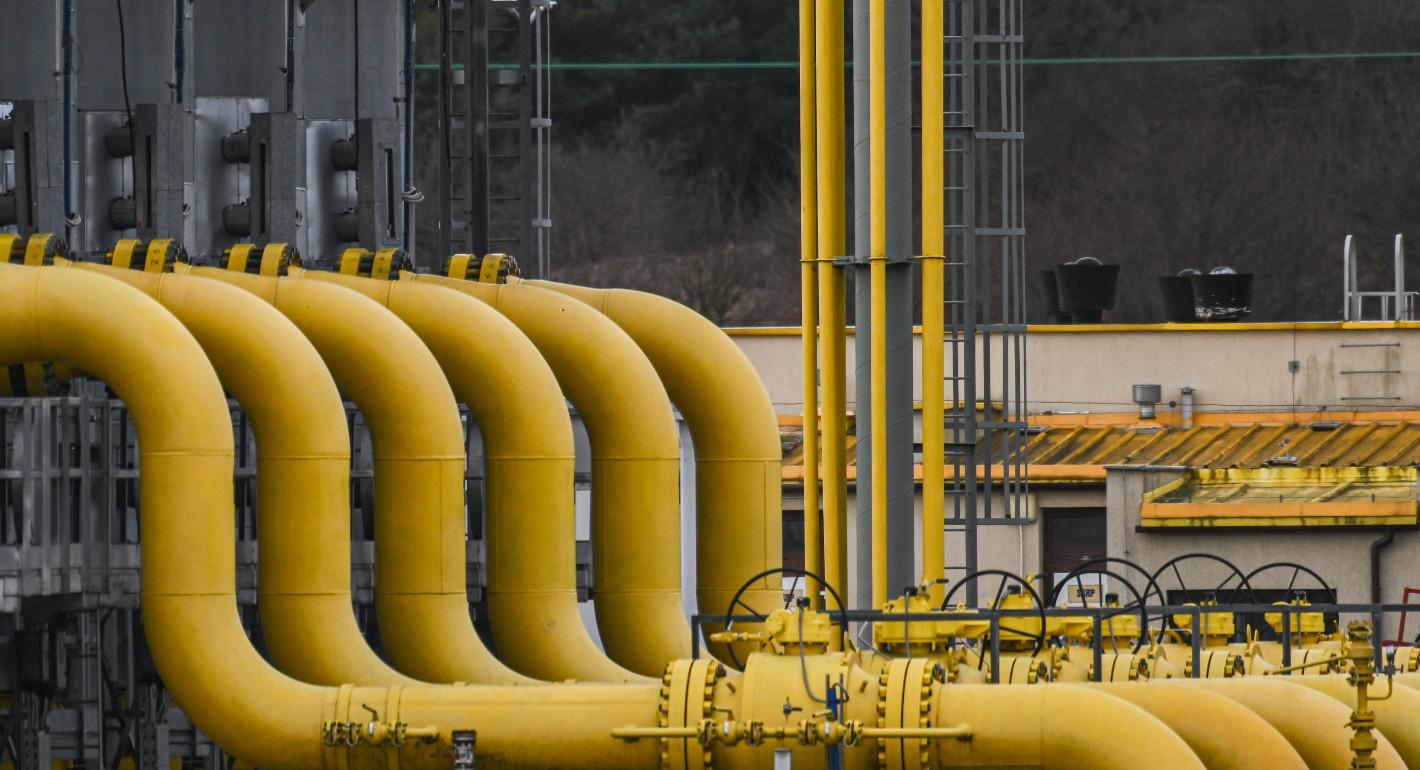
Since Russia invaded Ukraine last month, one question has remained at the center of transatlantic debates: Will the Russian gas keep flowing to Europe throughout this war?
Europeans have continued to buy Russian natural gas, even increasing their purchases, and gas trade remains exempted from sanctions. On Tuesday, the United States banned Russian oil and gas imports, but the UK opted to ban Russian oil, not gas, and the rest of Europe remains split on the merits of a Russian energy embargo. Poland, for instance, supports it, whereas German leaders argue that it would cause excessive economic damage and “threaten the social peace.” Russia has warned that it could shut off the gas as a countersanction, but for now it appears happy to take advantage of record prices, selling the EU more than 2 billion euros worth of gas every week and softening the blow of other sanctions.
Regardless of the scope and duration of any impending restrictions, the EU’s gas relationship with Russia, which survived every flashpoint of the Cold War, is on its last legs. The EU aims to reduce its dependence on Russian gas by 80 percent this year. Denmark intends to wean itself off Russian gas “as soon as possible” and London-based Shell has announced a “phased withdrawal” from Russian energy. Some of the policies being put forward to replace these fuels are clear climate wins. The REpowerEU plan announced this week includes measures to insulate buildings, replace gas boilers with heat pumps, and install more windmills and solar panels. Germany, which depends heavily on Russian gas, moved to accelerate its transition to 100 percent renewable electricity. None of these plans will be simply canceled the day that Moscow stops shelling Kyiv.
But Europe’s plan to replace Russian gas, which makes up 40 percent of its supply, is not entirely climate-friendly. The EU aims to maximize imports of pipeline gas from Norway and Algeria. It will pay record prices to import liquified natural gas (LNG) from places like Australia, Qatar, and the United States, and it plans to build more LNG terminals to enable higher imports in the future. It will burn more coal and perhaps even fuel oil to replace the gas usually burned in power plants. Because of this emphasis on fossil fuel alternatives, analysis from the International Energy Agency shows that an all-out drive to replace Russian gas would only result in a “modest decline in overall emissions.”
But from a global energy transition perspective, that’s not the point. European governments are preparing to quickly stop burning large quantities of a particular fossil fuel for reasons of national interest and indeed national security—a large-scale, state-driven, fossil fuel phase-down. And that’s an exceedingly rare thing.
On a global scale, humans tend to add new energy sources such as renewables to the existing mix rather than replace old fuels. Most examples of phase-downs come from the power sectors of individual countries, such as France with oil after the OPEC embargo of 1973, Germany with nuclear after the 2011 Fukushima disaster, or the UK with coal in the 1990s and 2010s.
This developing European phase-down could be catalytic for three reasons. First, it would be focused on gas. Whereas plans for coal power phase-outs abound in Europe and beyond, many still see gas as a bridge to a renewable future, not a harmful fossil fuel to be phased down in the 2020s. The European Commission recently included certain investments in gas-fired power in its taxonomy of “sustainable” green investments. No economy of this size has ever tried to rapidly eliminate a share of its gas consumption; from a climate perspective, it is good that one intends to try.
Second, the phase-down would be a highly visible effort across multiple sectors: power, industry, and heating. That means not just unseen changes at distant power plants, but citizens asking one another to turn down their thermostats, and workers coming to Europeans’ offices to install heat pumps and insulation. For the first time since the 1970s, leaders would again try to harness a patriotic wartime spirit in the service of energy efficiency and conversation. “If you want to hurt Putin a little, then save energy,” German Federal Minister for Economic Affairs and Climate Action Robert Habeck said on March 5.
Third, this phase-down involves politicians being willing to break old taboos. This war has persuaded the Greens in Belgium and Germany to contemplate delaying their cherished nuclear phase-outs, while the German Social Democrats agreed to halt the Nord Stream 2 pipeline that could have brought more gas directly from Russia to Germany. Conservative, business-friendly parties across Europe have backed sanctions that have forced EU energy firms to accept huge losses on now-toxic Russian investments. This war is changing the EU’s energy paradigm, just as the EU’s move to issue joint debt in response to the coronavirus pandemic changed its fiscal paradigm.
This watershed moment has made once-radical ideas now seem plausible. If already-cheap clean energy is to replace fossil fuels, governments need to be willing to change their assumptions, rewrite regulations, and fund programs as if they were facing an emergency in the energy sector—which they are. If Europe gets through this coming winter without Russian gas, every following winter and energy transition will be easier.

Former Fellow, Sustainability, Climate, and Geopolitics Program and Fellow, Europe Program
Noah J. Gordon was a fellow in the Sustainability, Climate, and Geopolitics Program at the Carnegie Endowment for International Peace in Washington, DC.
Recent Work
Noah Gordon, Liana Schmitter-Emerson



Sophia Besch, Eric Ciaramella, Steve Feldstein, …
Carnegie does not take institutional positions on public policy issues; the views represented herein are those of the author(s) and do not necessarily reflect the views of Carnegie, its staff, or its trustees.

Despite its flop at the box office, the film raises important questions for the climate community to answer.

Leonardo Martinez-Diaz

Funding Ukraine remains a priority for European leaders. As Russia’s war of aggression heads into another winter, two feasible options to mobilize support for Kyiv should be fast-tracked.


Vladyslav Rashkovan, Gregory P. Wilson

Russian strikes are weakening the economy sustaining Ukraine’s war effort. Closing the growing funding gap will require more European support and politically contentious reforms in Kyiv.

Balázs Jarábik

While the EU and European governments are embracing the much-lauded middle-power moment, this entails three difficult conundrums.

Richard Youngs
The middle power moment will not be defined by sovereign states alone, and California stands out for its potential contributions to international cooperation.


Ian Klaus, Stewart Patrick