

Paper
Christopher S. Chivvis, Rohan Mukherjee, Milan Vaishnav
{
  "authors": [
    "Christopher S. Chivvis"
  ],
  "type": "commentary",
  "centerAffiliationAll": "dc",
  "centers": [
    "Carnegie Endowment for International Peace"
  ],
  "collections": [],
  "englishNewsletterAll": "americanStatecraft",
  "nonEnglishNewsletterAll": "",
  "primaryCenter": "Carnegie Endowment for International Peace",
  "programAffiliation": "ASP",
  "programs": [
    "American Statecraft"
  ],
  "projects": [],
  "regions": [
    "North America",
    "United States",
    "Middle East",
    "Israel",
    "Palestine",
    "Eastern Europe",
    "Ukraine"
  ],
  "topics": [
    "Security",
    "Foreign Policy"
  ]
}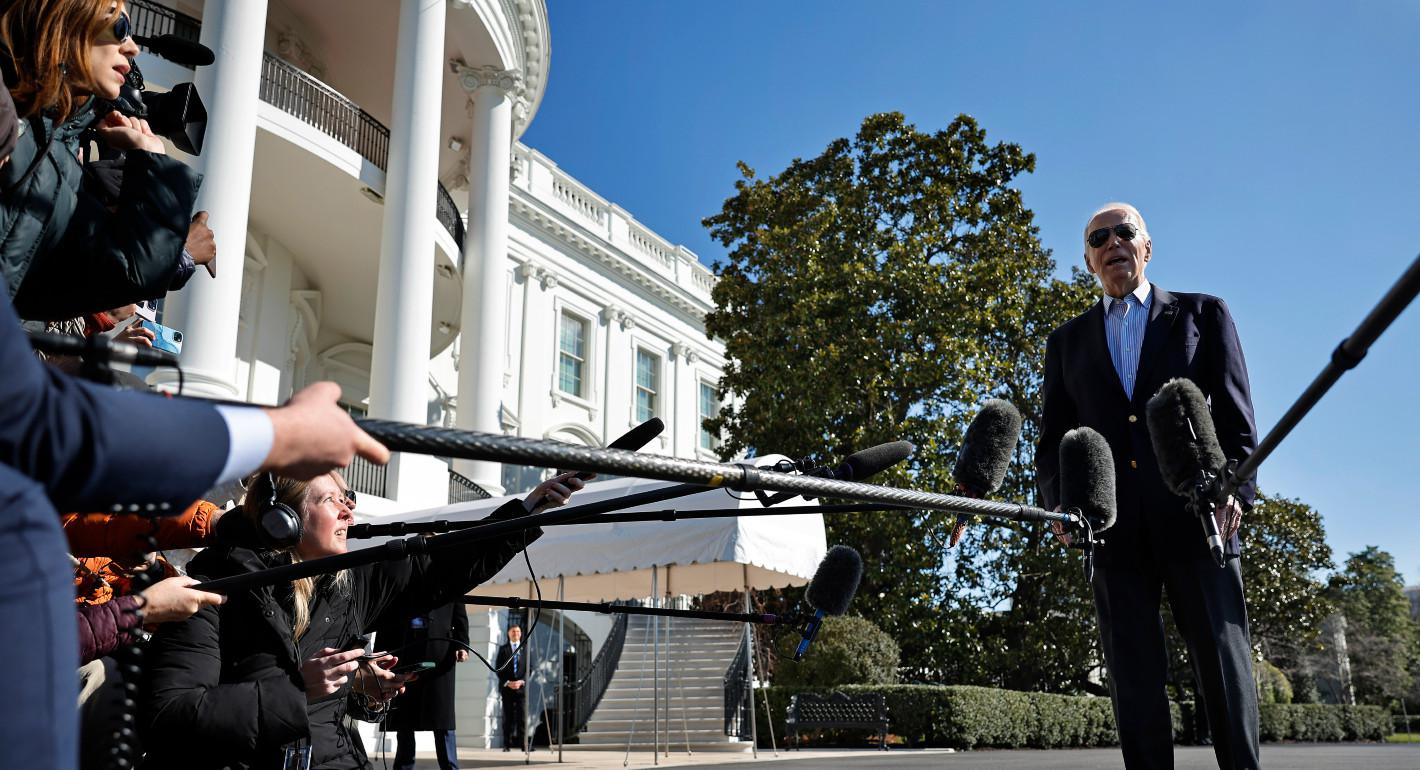
Source: Getty
The president needs to show that he can steer the country away from the global turmoil, as opposed to adding to it.
Foreign policy usually only takes up a few minutes in a State of the Union address that can stretch more than an hour. But on Thursday, when U.S. President Joe Biden delivers his annual speech to Congress, a lot is still on the line.
The world that America made seems to be coming apart at the seams. The White House faces hot wars in Europe and the Middle East and mounting tension in East Asia, among many other global challenges. Biden is at risk of getting blamed for the chaos—unfairly, perhaps—but Americans want reassurance that he is strong enough to defend their interests in this uncertain world. And with an upcoming presidential election, they need to see him as the candidate who will steer the country away from the global turmoil, as opposed to adding to it.
The image Biden conjures when addressing foreign policy in his speech will matter a great deal. Will he offer a vision of clarity and leadership, or will he seem equivocal or uncertain? In addition, his remarks will need to fortify his core political and ethical arguments against likely Republican nominee Donald Trump.
In the past, Biden has cast the current moment as a contest between democracy and autocracy—“light will win over darkness,” as he said in 2022, echoing Ukrainian President Volodymyr Zelensky. This is aimed in part at Trump, whose openness to autocrats such as Russian President Vladimir Putin and North Korean leader Kim Jong Un has heightened concerns about the former president’s own autocratic impulses.
But Biden needs to show that his foreign policy is delivering concrete benefits for the American people and that he’s not spending too much time or money on it. As Democratic political heavyweight David Axelrod told the New Yorker, “I’m pretty certain in Scranton they’re not sitting around their dinner table talking about democracy every night.” It’s unclear whether a reference to the billions of dollars in Ukraine aid legislation currently blocked by House Republicans will help or hurt Biden when it comes to the things folks in Scranton really are concerned about. Attacking the House Republicans may stir Democrats’ partisan ire, but it won’t clear the gridlock in Congress or do much of anything to help Ukraine.
Biden faces the challenge that, three years into his term, the intellectual and ethical bases that once helped distinguish his foreign policy from Trump’s are becoming muddled in a world that has often resisted his plans for it. The most glaring example of this conflict is the tension between Biden’s high-minded and expansive approach to Ukraine and his approach to the Middle East, where he is caught between America’s long-standing commitment to Israel and the reality of Israel’s brutal bombing campaign in Gaza.
Biden must address Gaza head-on. He needs to show much more empathy for the Palestinians and demonstrate that he is doing something meaningful to alleviate their suffering. Absent a diplomatic breakthrough, however, the best he can do is highlight the recent U.S. operation to airdrop humanitarian aid to Gaza’s imperiled citizens.
Whether this will convince his base that he is in the right place is far from certain. The American people can tolerate a degree of contradiction in U.S. foreign policy, but in this case, the gap between word and deed may have grown too large. This is especially true for younger voters, who were important for Biden’s 2020 victory but are now wondering whether his foreign policy is really that much more ethical than Trump’s.
Biden does have some important foreign policy successes he may try to highlight.
On China, for example, his administration has managed a difficult and potentially dangerous relationship amid strong domestic political headwinds. It shepherded the CHIPS and Science Act of 2022—major bipartisan legislation—through a fractious Congress. The act should strengthen the United States for long-term competition with China while boosting the domestic economy and economic cooperation with key allies.
His early decision to withdraw from Afghanistan was a strategic necessity. He may want to remind the world how much worse America’s situation would be if U.S. troops were still at war there with the Taliban.
Biden may also mention that his administration is making a serious effort to combat climate change—both at home and abroad—even if progress on international agreements has been limited.
Four years ago, Biden ran on the claim that he would run a foreign policy that restored America’s global image, stood up against autocrats, and projected America’s traditional role in the world after the chaotic lurches of the Trump years—all while adjusting its global commitments to the twenty-first century and delivering a foreign policy for the American people. The past three years have revealed the challenges of putting this vision into practice.
On Thursday, voters will begin to consider whether they want to continue down that path.

Senior Fellow and Director, American Statecraft Program
Christopher S. Chivvis is the director of the American Statecraft Program at the Carnegie Endowment for International Peace.
Recent Work


Christopher S. Chivvis, Rohan Mukherjee, Milan Vaishnav
Christopher S. Chivvis, Senkai Hsia
Carnegie does not take institutional positions on public policy issues; the views represented herein are those of the author(s) and do not necessarily reflect the views of Carnegie, its staff, or its trustees.

The EU can impose sanctions but struggles to enforce them without the United States. With Washington increasingly disinterested in backing European interests, the bloc must now fend for itself.


Nicu Popescu, Tiago Antunes
Global and rising powers will need to engage with Africa’s priorities and agency in order to secure the continent’s increasingly attractive partnerships.
Fonteh Akum

Rubio’s recent visit brought welcome attention, but more capital requires governance changes that may be a hard sell for regional governments.

Jennifer B. Murtazashvili

America’s foreign-policy objectives have grown more demanding while Americans have demanded greater focus on their own affairs.

Stephen Wertheim

Japan’s long-term security policy is driven by concerns about China, and there is little appetite for (or interest in) pursuing a confrontation with Moscow.

James D.J. Brown