

Commentary
The Bureau of Industry and Security needs to adjust its focus and practices to maintain its position as the U.S. government’s primary champion of international technological competition.
Geoffrey Irving
Source: Getty
Crimea is the most serious potential conflict in postrevolutionary Ukraine. The crisis could lead to a hot war in Ukraine and dramatically increase tensions between Russia and the West—no effort should be spared to avert this scenario.
The mounting conflict over the status of the autonomous republic of Crimea deserves an urgent, careful response. Of all the potential conflicts in postrevolutionary Ukraine, none is more important than a serious crisis in Crimea, which could lead to a hot war in Ukraine and dramatically increase tensions between Russia and the West.
Events are moving quickly.
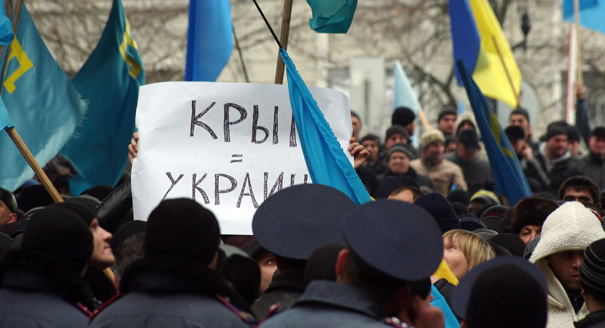
Earlier today, demonstrators waving Russian flags broke through police lines at the local parliament building in Simferopol, Crimea’s capital, and the leadership of parliament announced plans for Crimea to hold a referendum in May on upgrading its autonomous status within Ukraine. For the second day, dueling groups of demonstrators in front of parliament are chanting slogans in favor of and against secession. That sets the region on a collision course with the newly formed government in Kyiv and could lead to the de facto breakup of Ukraine.How did this happen?
Over the weekend, a large crowd in Sevastopol, home to the Russian Black Sea Fleet, had installed a local businessman and Russian citizen as the city’s new mayor. Soon thereafter, local political leaders explicitly rejected the authority of the new leadership in Kyiv.
Suggestions by Russian parliamentarians to distribute passports to co-ethnics in the region and a surprise large-scale military drill ordered by Russian President Vladimir Putin yesterday, February 26, immediately evoked memories of Russian actions leading up to the Russia-Georgia war of August 2008. Barricades and checkpoints are also being set up in various parts of the peninsula by local self-defense forces, and Russian military vehicles have been spotted on the roads outside their bases, according to Western journalists.
The provisional authorities in Kyiv led by acting President Oleksandr Turchinov are not shying away from confrontation. Today Turchinov said that any further Russian military moves outside their bases in the region would be considered acts of “aggression.” Controversial actions by the Ukrainian Verkhovna Rada immediately after the collapse of the government of Viktor Yanukovych increased tensions. The parliament’s moves included the revocation of a controversial language law that had allowed local governments in the areas where Russian was widely spoken to enshrine it as an official language on par with Ukrainian. Meanwhile, ultranationalist groups such as Svoboda (Freedom) and Praviy Sektor (Right Sector) that took the lead in the street fighting in Kyiv are now assuming prominent roles in state security bodies, triggering alarms in Moscow and beyond.
Crimea is a very special—and delicate—case. It is Ukraine’s only autonomous republic, though its autonomy was sharply curtailed in the mid-1990s. Its population of nearly 2 million is about 60 percent Russian, many of whom are retired Russian military personnel. Russia’s naval base in Sevastopol is home to some 15,000 active-duty servicemen, and much of the city essentially lives off of the base. About 12 percent of Crimeans are Tatars, who are generally loyal to Kyiv due to their tragic history. (They were persecuted and repatriated by Stalin for alleged disloyalty at the end of World War II and were only able to return to Crimea at the very end of the Soviet period.) Throughout independent Ukraine’s twenty-plus-year history, Crimea’s residents, only 24 percent of whom are ethnic Ukrainians, have seen themselves as a breed apart from the Ukrainian mainstream.It would be a surprise if Russia moved to annex the region outright. Although Putin has maintained his silence on the situation in Ukraine since this past weekend, events on the ground are challenging Ukraine’s territorial integrity and raising the possibility that Russian troops will become directly involved in pulling the country apart.
Putin’s hand could be forced (and conflict could come to the region inadvertently) depending on how the new authorities in Kyiv respond to recent moves by the local population. One can easily imagine a harsh Russian response if Kyiv takes rash steps to reassert its authority in Crimea either by sending in troops or by allowing revolutionary paramilitaries to launch a “people’s march” on Crimea. One of the most worrisome by-products of the Ukrainian revolution is the fact that there are now far more guns and advanced weaponry in the hands of nonstate actors than at any point in the country’s post-Soviet history.
That means there is a greater risk that even small incidents could have major ramifications. The recent severe deterioration in relations between Moscow and the United States and the EU over Ukraine is an additional source of unpredictability. Russian leaders believe, rightly or wrongly, that the West drove events in Ukraine to the brink of collapse to secure geopolitical advantage over Moscow. Thus, Western appeals for Russian restraint in the event of a crisis over Crimea are unlikely to resonate. The facts that U.S.-Russian high-level lines of communication remain extremely contentious and that the U.S. ambassador to Moscow, Michael McFaul, has just left his post with no replacement in sight provide additional sources of concern.
Still, there are several possible steps that might help head off the most dangerous scenarios:
The situation in Ukraine has already surprised many experienced observers. What was once seen as impossible has now become all too conceivable. A hot war between Russia and Ukraine would have far-reaching and highly destabilizing consequences, and a transformative effect on Russia’s relations with the West. No effort should be spared to promote a rapid de-escalation of the situation on the ground.
Former Director, Carnegie Moscow Center
Trenin was director of the Carnegie Moscow Center from 2008 to early 2022.
James Family Chair, Vice President for Studies
Andrew S. Weiss is the James Family Chair and vice president for studies at the Carnegie Endowment for International Peace, where he oversees research on Russia, Ukraine, and Eurasia. His graphic novel biography of Vladimir Putin, Accidental Czar: the Life and Lies of Vladimir Putin, was published by First Second/Macmillan in 2022.
Carnegie does not take institutional positions on public policy issues; the views represented herein are those of the author(s) and do not necessarily reflect the views of Carnegie, its staff, or its trustees.

The Bureau of Industry and Security needs to adjust its focus and practices to maintain its position as the U.S. government’s primary champion of international technological competition.

Geoffrey Irving
They face an uphill climb, but they could draw on a strategy that other diplomats have used in the past.


Shana Tabak, Alejandro Martin Rodriguez
Despite myriad challenges and occasional stumbles, the new Hungarian government is moving ahead with energy and conviction to uproot years of illiberalism and corruption and rebuild Hungarian democracy.

Thomas Carothers

European Commission President Ursula von der Leyen is about to give her annual address on the state of the EU. Here’s what she won’t—but should—say.

Rym Momtaz

Depleted financial reserves and a shrinking tax base mean it is no longer possible to simultaneously deliver high defense spending, price stability, and economic growth.

Alexandra Prokopenko